
This guide is written for business buyers. Confirm product applications, technical data, commercial terms and market requirements with the selected supplier before ordering.
A mixed filter order can look complete on a quotation and still be difficult to ship. Most lines may be ready, while one reference is waiting for approval and another needs revised packaging. The purchasing decision is then no longer just about price: do you wait, split the shipment, or remove a line?
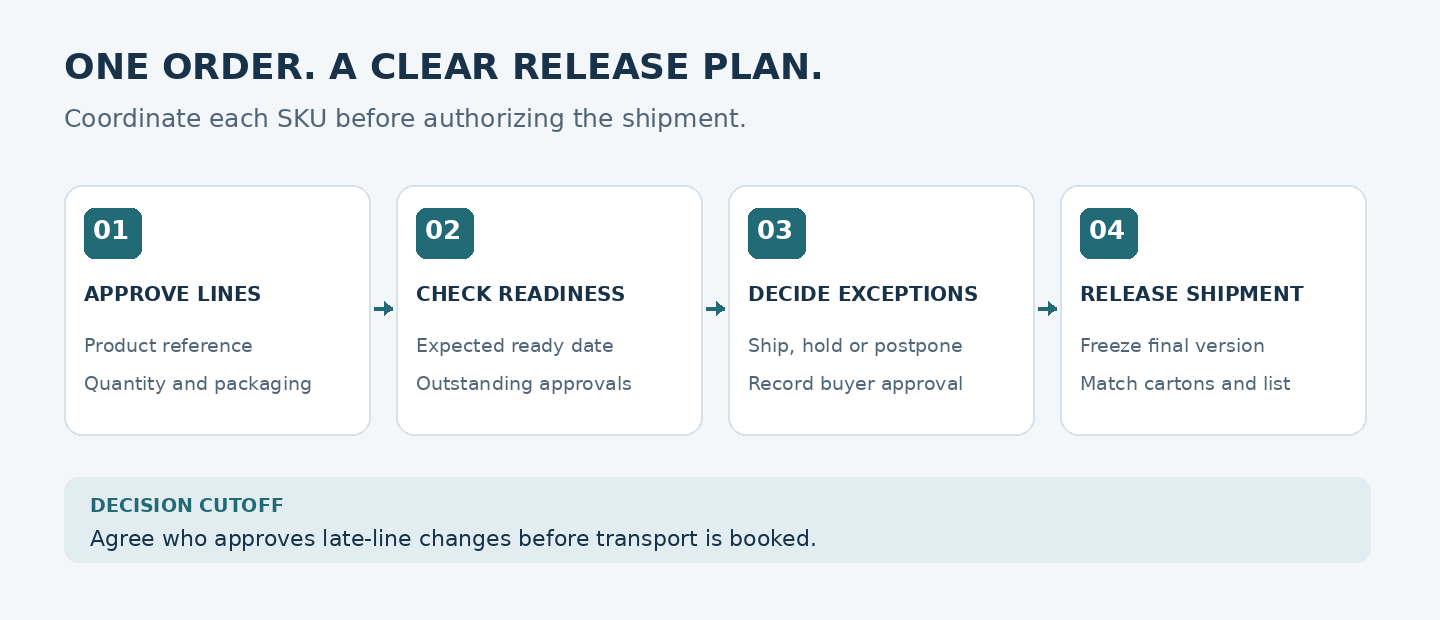
To consolidate multiple automotive filter SKUs into one wholesale order, agree a release plan for each line and a shipment rule for the whole order. Keep product approval, quantities, packaging and readiness visible in one controlled file. Then make exceptions explicit before booking transport.
This guide is for distributors and importers moving from an initial quotation to an executable order. If you are still preparing your first inquiry, start with our small-batch filter quotation guide.
1. Define what “one order” means
One purchase order, one payment arrangement and one shipment are separate decisions. A purchase order can contain several agreed shipment releases. Equally, combining products into one shipment does not mean they can share the same retail packaging, approval record or production schedule.
Before confirming the order, agree whether the supplier must hold every line until the full order is ready, release an approved group first, or seek your written decision when a line misses the cutoff. Also confirm whether consolidation is limited to products supplied under that order. Do not assume collection from unrelated suppliers is included.
2. Keep one master order file
Give each line a stable buyer SKU or line ID, alongside the supplier’s quoted reference. Preserve the OE or cross-reference information, but do not use a similar-looking number as permission to substitute a product.
The master file should answer five practical questions: what was approved, how much is ordered, which packaging revision applies, when the line is expected to be ready, and whether it is authorized for shipment. A date alone cannot answer all five.
When a quantity or specification changes, issue a revised file with a date and version number. Ask the supplier to acknowledge the changes. Avoid treating several different spreadsheets in an email thread as equally current.
3. Separate product approval from shipment readiness
“Ready” needs a shared definition. A line may be available but still awaiting your sample decision, artwork approval or an agreed inspection record. Mark these as separate steps so a packaging delay does not disappear behind a general production update.
For an uncertain reference, record the open question and the person responsible for resolving it. Our Filter Finder can help locate published references; a catalog result does not replace application and specification approval for the order.
Minimum quantities also remain a line-level question. Combining ten references into one purchase order does not automatically satisfy each product’s MOQ or a separate printed-box minimum. If quantities must be rounded to full cartons, approve the revised quantity and order value before release.
4. Agree how to handle a late SKU
Consider this illustrative order. The dates and quantities below are planning examples, not a Haolincfilter stock or lead-time offer.
| Order line | Quantity | Expected readiness | Open action |
|---|---|---|---|
| Oil filter A | 300 pieces | Week 2 | Confirm release checks |
| Air filter B | 120 pieces | Week 3 | Approve carton label |
| Cabin filter C | 200 pieces | Unconfirmed | Resolve product specification |
Waiting for all three may suit a buyer who needs one coordinated receipt. Releasing A and B may suit a buyer who needs those items sooner. Removing or postponing C may be appropriate if its specification cannot be resolved in time. Each option needs an agreed effect on payment, storage, packaging and transport arrangements.
Set a decision cutoff: by the agreed review date, confirm in writing which lines may ship, which must be held and who approves changes. Do not allow an unapproved substitute to become the shortcut for completing the shipment.
5. Connect the order to the cartons
Your receiving team should be able to connect a carton to an order line without opening every box. Agree carton numbering, the buyer and supplier references to display, quantities per carton and any batch information required for your receiving records.
If different SKUs share a master carton, request a contents breakdown. If they share a pallet, the packing list should show where those cartons belong. Keep changes to carton quantity or packing method synchronized with the order file.
Where your distribution system requires GS1 logistics identification, confirm the required label and data format before packing. GS1 identifies individual logistics units using an SSCC; this is different from the product reference used to identify a filter. Confirm your customer’s requirements rather than assuming every mixed order needs the same label.
6. Compare the actual shipment options
Combining lines may simplify coordination, but do not assume it always reduces total cost. Ask for the shipment’s estimated carton count, dimensions, weight and volume after the packing plan is agreed. Bulky air and cabin filters can make the shipment profile quite different from a group of compact oil filters.
For a split shipment, compare the additional freight, handling and document charges against the effect of waiting for the delayed items. Confirm the delivery term and named place for each option. Use the current forwarder quotation and agreed commercial terms, rather than a general savings percentage.
7. Freeze the release version before dispatch
Before authorizing dispatch, check the final release file against the commercial invoice and packing list. Match shipped references and quantities, identify any short-shipped or held lines, and confirm that the agreed labels and packaging revisions are reflected.
Keep a short record of what remains open and how it will be handled. That gives the next replenishment order a clear starting point, rather than an unresolved difference hidden in the previous shipment.
Discuss your next mixed-SKU filter order
Haolincfilter manufactures and supplies automotive filters for wholesale and private-label programs. Send your proposed references, quantities and destination, together with the items needed first and your preference for one shipment or phased releases. We can review the requested scope and discuss a product-specific quotation and delivery plan.
For printed packaging, include the current artwork and label requirements with your private-label brief. Product availability, MOQ, packaging and shipment arrangements should be confirmed in the written offer for your order.