
This guide is written for business buyers. Confirm product applications, technical data, commercial terms and market requirements with the selected supplier before ordering.
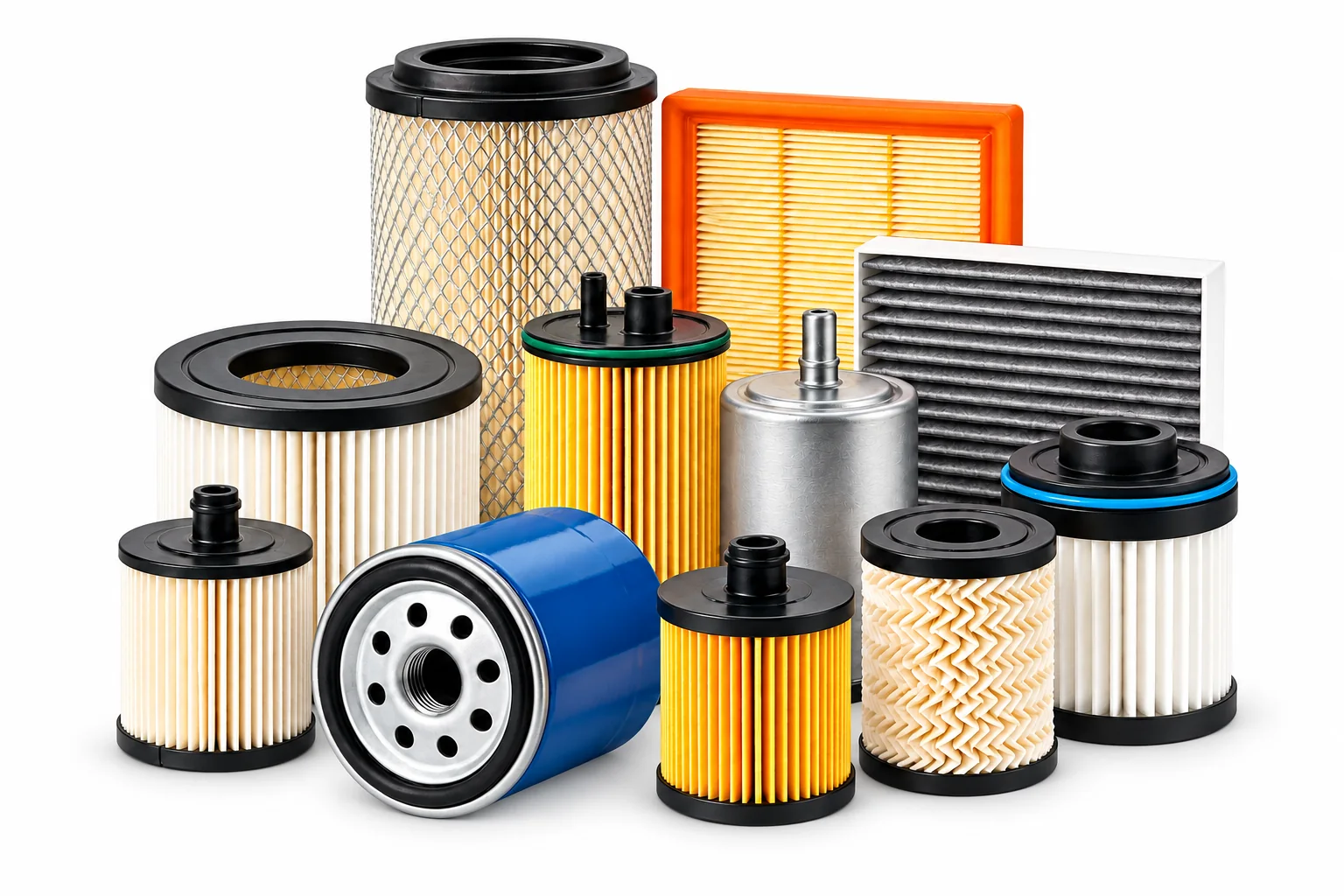
For an automotive parts importer or wholesale distributor, “oil filter” can describe more than one product format. A spin-on oil filter is commonly supplied as a complete sealed unit, while a cartridge-style service part is typically an element intended for a reusable housing. That difference affects fitment data, packaging, catalog mapping and the questions to include in a purchase order.
The format alone does not confirm interchangeability. Always verify the exact application and reference data before adding a product to a wholesale range or approving a private-label listing.
What is the difference between spin-on and cartridge oil filters?
A spin-on design combines the filter element and its housing in a replaceable canister. A cartridge filter is generally a replaceable element fitted inside a separate housing that remains on the engine. These descriptions are useful for organizing a catalog, but vehicle design and service procedures vary. Confirm the correct part by OE/OEM reference and application, not by appearance or format alone.
1. Confirm what the quoted SKU actually includes
Ask whether the part number refers to a complete spin-on assembly or only a cartridge element. For cartridge applications, clarify whether any service components—such as a seal or cap insert—are included, separately supplied, or not part of the offer. For a spin-on item, confirm the product is the complete unit and identify the application reference used for the match.
Write the included components into the RFQ and quotation line. This simple detail prevents buyers, suppliers and warehouse teams from interpreting the same SKU differently.
2. Match the application and OE/OEM references
Provide the OE/OEM number, vehicle make and model, model year, engine details where available, and destination market. If the request uses a competitor or aftermarket cross-reference, identify its source. Ask the supplier to return the references checked and flag any application that needs clarification rather than silently treating similar-looking parts as equivalent.
Where multiple references or revisions exist, keep each candidate in a separate row. A clean reference map makes it easier to compare a wholesale oil filter catalog and review the product data before placing a bulk order.
3. Check the fitment-critical details
For a spin-on filter, confirm the thread, gasket/sealing interface, overall dimensions and application reference against the approved data for that exact part. For a cartridge element, confirm the element dimensions, end configuration, sealing features and housing application. Do not substitute a visual measurement for a validated fitment match.
Internal features can also vary by application. If a particular design feature—such as a bypass or anti-drainback function—is required, state it in the specification and request evidence tied to the exact SKU. Do not infer a feature from the filter’s external shape.
4. Approve samples against a written specification
Before a first bulk order, identify which sample is being approved: part number, revision, references, dimensions, included components and packaging. Record any agreed inspection points and the evidence expected. A sample approval should be specific enough that a later shipment can be compared with the agreed item.
For a useful review workflow, see our automotive filter sample approval checklist and product data checklist for distributors.
5. Keep the catalog and packaging clear
Catalog listings should state whether the item is spin-on or cartridge, identify the exact SKU and reference basis, and avoid combining two formats under one product record. For private-label programs, align the carton and product label with the approved part number, brand artwork, quantity unit and reference list. Confirm barcode and label data before printing.
When planning a mixed-SKU order, request a line-by-line quotation showing quantity per SKU and packaging assumptions. This makes comparisons between oil filter suppliers more meaningful than a single blended unit price.
Oil filter sourcing RFQ checklist
- OE/OEM number and source of any cross-reference
- Vehicle application and destination market
- Spin-on assembly or cartridge element, stated explicitly
- Dimensions and fitment-critical details for the exact item
- Included service components, if applicable
- Sample approval and required evidence
- Quantity per SKU, packaging and private-label requirements
Frequently asked questions
Can a cartridge oil filter replace a spin-on filter?
Not simply because both are oil filters. They are different product configurations. Confirm the application and OE/OEM references for the vehicle before selecting a replacement.
Which format is better for a wholesale program?
Neither format is universally better. The right assortment depends on your target vehicle parc, customer demand, verified references, storage and service-market requirements. Build the range around confirmed applications rather than choosing by format alone.
What information helps an oil filter supplier quote accurately?
Send the reference list, application details, quantities by SKU, packaging or private-label brief, destination market and any sample or documentation requirements. You can submit those details through our filter quotation form.
Conclusion
For importers sourcing spin-on and cartridge oil filters, the key is a precise product definition: what the SKU includes, which application and references it covers, and how the approved sample and packaging are recorded. Clear line-item data helps reduce avoidable fitment questions and supports a more dependable wholesale purchasing process.